


Hey there! As a supplier of European standard cables, I often get asked about the power rating of these cables. It's a crucial topic, especially for those in the electrical and construction industries. So, let's dive right in and break it down.
First off, what exactly is power rating? Power rating is the maximum amount of electrical power that a cable can safely handle. It's typically measured in watts (W) or kilowatts (kW). This rating is determined by several factors, including the cable's conductor material, cross - sectional area, insulation type, and the ambient temperature in which it operates.
Let's talk about some common types of European standard cables and their power ratings.
H03VVH2 - F
One of the popular cables in our product line is the H03VVH2 - F. This cable is known for its flexibility and durability. It's often used in low - voltage applications, like in household appliances, small electrical equipment, and control circuits.
The power rating of the H03VVH2 - F cable depends on its cross - sectional area and the number of conductors. For example, a cable with a smaller cross - sectional area, say 0.75 mm², will have a lower power rating compared to one with a 1.5 mm² cross - sectional area. Generally, for a 0.75 mm² H03VVH2 - F cable operating at a voltage of 300/500V (a common voltage in many European applications), the power rating might be around 1 - 2 kW, depending on the installation conditions. If the cable is installed in an area with good ventilation and low ambient temperature, it can handle more power. But if it's in a confined space or a high - temperature environment, the power rating will be reduced.
H07V - R Class 2 Stranded Conductor
The H07V - R Class 2 Stranded Conductor is another great option. It's designed for more heavy - duty applications, such as in industrial machinery, power tools, and outdoor lighting systems.
This cable has a higher power - handling capacity due to its larger cross - sectional area and the nature of its stranded conductors. For instance, a 2.5 mm² H07V - R cable can typically handle a power rating of around 3 - 5 kW at 400/690V. The stranded conductors in this cable allow for better flexibility and current - carrying capacity compared to solid conductors. However, just like with any cable, the power rating can be affected by factors like the length of the cable run. A longer cable run will result in more resistance, which in turn can reduce the power that the cable can safely transmit.
H05RR - F Cable
The H05RR - F Cable is a flexible rubber - sheathed cable. It's commonly used in portable electrical equipment, like vacuum cleaners, electric drills, and other hand - held tools.
The power rating of the H05RR - F cable is relatively lower compared to some of the other cables we've discussed, mainly because it's designed for lower - power applications. For a 1.0 mm² H05RR - F cable, operating at 300/500V, the power rating could be around 0.5 - 1.5 kW. The rubber sheath provides good insulation and protection against mechanical damage, but it also has some thermal properties that can affect the cable's power - handling ability.
H03VV - F
The H03VV - F is a single - core cable used in many general - purpose electrical installations. It can be found in domestic wiring, lighting circuits, and some small - scale industrial applications.

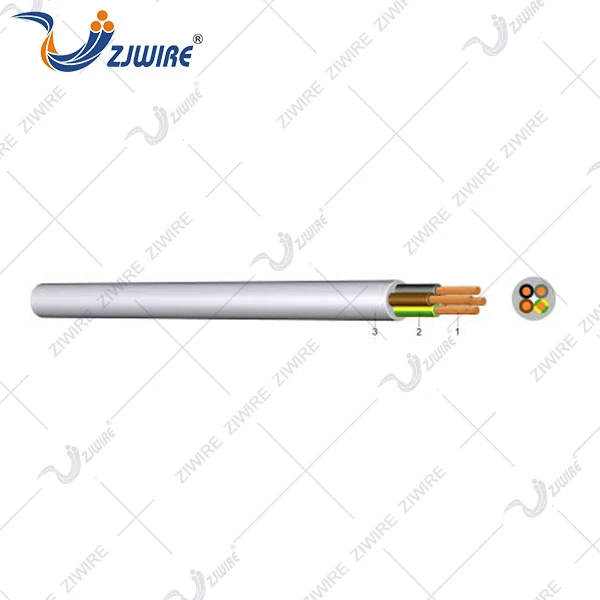
The power rating of the H03VV - F cable varies with its cross - sectional area. A 0.5 mm² H03VV - F cable might have a power rating of about 0.3 - 1 kW at 300/500V. This cable is known for its simplicity and cost - effectiveness, but you need to make sure to choose the right cross - sectional area based on your power requirements.
H07V2 - K Cable
The H07V2 - K Cable is a robust cable designed for high - performance applications. It's often used in heavy - duty industrial machinery, construction sites, and large - scale electrical systems.
This cable has a high power - handling capacity. A 4 mm² H07V2 - K cable can handle a power rating of around 6 - 10 kW at 400/690V. The double - insulated design of the H07V2 - K cable provides an extra layer of safety, especially in high - voltage and high - power applications.
It's important to note that these power ratings are just estimates. The actual power rating of a cable can be affected by a variety of factors. For example, the ambient temperature plays a big role. If the cable is installed in an area where the temperature is very high, the insulation can degrade more quickly, and the cable's ability to carry current safely will be reduced. Similarly, if the cable is installed in a conduit or a cable tray with a lot of other cables, the heat generated by the other cables can also impact its power rating.
Another factor to consider is the type of load. Resistive loads, like heaters, have a different power - consumption pattern compared to inductive loads, like motors. Inductive loads can cause voltage drops and additional heat generation, which can affect the cable's performance and power rating.
When choosing a European standard cable for your project, it's crucial to calculate the power requirements accurately. You need to consider the total power of all the devices that will be connected to the cable, as well as any potential future expansions. It's also a good idea to leave some margin for safety. For example, if your devices have a total power requirement of 3 kW, it might be wise to choose a cable with a power rating of 4 - 5 kW to ensure reliable and safe operation.
As a European standard cable supplier, we're here to help you make the right choice. Our team of experts can assist you in selecting the cable with the appropriate power rating for your specific application. We understand that every project is unique, and we're committed to providing you with high - quality cables that meet your needs.
If you're in the market for European standard cables, whether it's for a small home project or a large - scale industrial installation, don't hesitate to reach out. We can provide you with detailed information about our products, including their power ratings, technical specifications, and pricing. Let's work together to ensure your electrical system runs smoothly and safely.


