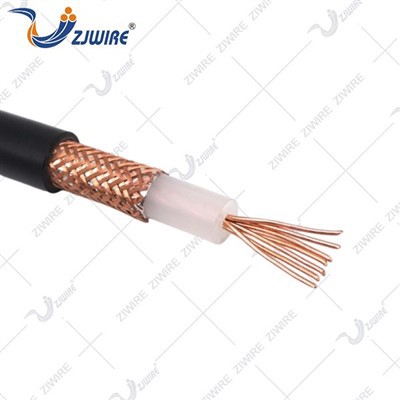
Why do some copper wires bend easily like ropes while others show creases when bent? Is it because of poor material quality? Not entirely. The key lies in the structure!
Let's start with the most straightforward explanation. A single solid wire has a lower resistance and conducts electricity well, but when bent, the outer side stretches and the inner side compresses. The strain accumulates, quickly exceeding the limit. As a result, it cannot return to its original shape and may break over time. However, if multiple thin strands are twisted together, the situation changes. The bending force is distributed among each strand, and the strands can slide against each other, as can the layers. The force is no longer concentrated at one point but is spread out. This technique is called "divide and conquer," and it's how flexibility is achieved!
Next, let's talk about the tightness of the twisting. The term "lay ratio" is not difficult to understand. It's the ratio of the pitch to the outer diameter. A smaller ratio means tighter twisting, resulting in a more solid structure. The strands won't move around when bent back and forth. However, there are downsides. Production becomes more difficult, resistance increases, and the feel becomes harder. A larger ratio makes production easier and reduces costs, but the structure becomes looser. If bent too much, the individual strands may slide excessively and even break through the insulation. Is a smaller ratio always better? Not necessarily. It depends on the application.
Another often overlooked detail is the twisting direction. The inner layer should twist to the left and the outer layer to the right, or vice versa. This counteracts the torsion introduced during manufacturing, preventing the wire from coiling on the table or kinking. The dynamic bending life improves. Many people overlook this, and when the machine runs, the wire dances in the slots, causing trouble.
Now, let's look at the diameter of the individual strands. Thinner strands are softer, which is common knowledge. For the same cross-sectional area, the thinner the strands, the lower the surface strain each strand bears when bent, resulting in a more stable lifespan. However, problems arise. Controlling the payout tension becomes more difficult, the risk of strand breakage increases, and the production line needs to be more precise. The equipment must keep up. This is not just about the material list.
Don't skimp on annealing. Copper wire pulled out has elongated crystal lattices and high internal stress, making it feel hard and brittle. Even if it looks soft on the outside after being made into multiple strands, the inside is still tight. If the annealing is not done properly, the wire will be soft on the outside but hard on the inside. After bending for a while, the strands will secretly break, reducing conductivity and causing occasional faults. Proper annealing restores the softness and conductivity of the copper, and the twisted wire will be truly soft.


If you want a softer wire, use thinner strands, a smaller lay ratio, alternate the twisting directions between layers, and anneal properly. Don't change the cross-sectional area, keep the tension stable, don't wrap the insulation too tightly, and ensure the insulation thickness and terminal connection forms are compatible. Follow up with bending tests. These steps seem simple, but they all involve expertise.
Now, the question arises: Can we have it all-softness, durability, and cost-effectiveness? In reality, there are always trade-offs. Pursuing extreme softness requires thinner strands and a smaller lay ratio, which reduces production capacity, increases costs, and raises DC resistance and heat generation. On the other hand, if the structure is overly tightened, there is no room for sliding, and the wire becomes stiff, showing white marks when bent. At this point, it's a matter of design trade-offs, with the application scenario being the deciding factor.
For example, in the case of drag chain cables, these wires are used in equipment that moves back and forth day and night, with millions of bending cycles. How to formulate the recipe? A common approach is to use bundled and stacked twisting, with multiple layers inside and out, and a gradient lay ratio that gradually increases from the inside to the outside. The inner layers ensure stability, while the outer layers provide flexibility. The twisting directions of adjacent layers are opposite, providing torsion resistance and preventing coiling. This combination is widely used in many factories and is constantly being fine-tuned.
Some may ask, what are the exact parameters? Is it based on the experience of the master? In the past, it was mostly based on experience, but now it's different. First, identify the failure mode, then reverse-engineer the parameters, conduct simulations, make sample wires, test on test stands, and add cycles. Let the data speak. However, don't blindly trust the software. Dust and oil in the field, the force of terminal crimping, and the bending radius during installation all affect the results.
In short, flexibility is not just about being soft. The structure is internal, the process is in the hands, the application is in front, and the budget is behind. Whoever can integrate these aspects will have a more durable wire. What's the next step? Should we continue to pile on materials or accurately calculate the parameters? Which path do you think is better? Welcome to contact Zhejiang Zhongjing Cable Co., Ltd. for discussion.