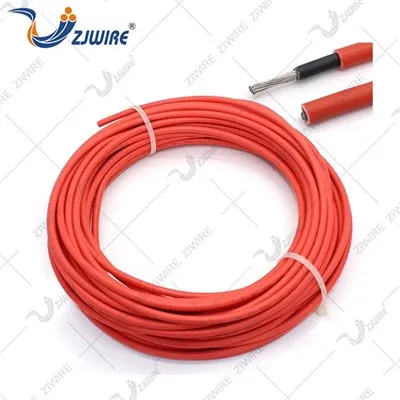
As a PVC insulated wire supplier, understanding how to calculate power loss in PVC insulated wire is crucial for both our customers and our business. Power loss in electrical wires can have significant implications for energy efficiency, system performance, and cost. In this blog, I'll delve into the factors affecting power loss in PVC insulated wire and provide a step - by - step guide on how to calculate it.


Factors Affecting Power Loss in PVC Insulated Wire
Resistance of the Wire
The resistance of a wire is one of the primary factors influencing power loss. According to Ohm's law, the resistance (R) of a wire is determined by its material, length (L), cross - sectional area (A), and temperature. The formula for resistance is (R=\rho\frac{L}{A}), where (\rho) is the resistivity of the wire material. For copper, a commonly used material in PVC insulated wires, the resistivity at room temperature ((20^{\circ}C)) is approximately (1.72\times10^{-8}\Omega\cdot m).
The longer the wire, the higher its resistance. As the cross - sectional area of the wire increases, the resistance decreases. This means that a thicker wire will have less resistance and thus less power loss compared to a thinner wire of the same length.
Current Flow
The amount of current (I) flowing through the wire also plays a vital role in power loss. The power loss (P) in a wire is calculated using the formula (P = I^{2}R). This shows that power loss is proportional to the square of the current. Even a small increase in current can lead to a significant increase in power loss.
Temperature
Temperature can affect the resistivity of the wire material. As the temperature rises, the resistivity of most metals, including copper, increases. This means that higher temperatures will result in higher resistance and, consequently, more power loss. PVC insulation also has a temperature rating, and if the wire operates above this rating, it can degrade the insulation and further increase the risk of power loss and safety hazards.
Step - by - Step Guide to Calculating Power Loss
Step 1: Determine the Resistance of the Wire
First, you need to know the length (L) and cross - sectional area (A) of the wire. The cross - sectional area of a circular wire can be calculated using the formula (A=\pi r^{2}), where (r) is the radius of the wire.
For example, if you have a copper wire with a length of 100 meters and a cross - sectional area of (2.5mm^{2}) (or (2.5\times10^{-6}m^{2})), and using the resistivity of copper (\rho = 1.72\times10^{-8}\Omega\cdot m), the resistance can be calculated as follows:
(R=\rho\frac{L}{A}=(1.72\times10^{-8}\Omega\cdot m)\times\frac{100m}{2.5\times10^{-6}m^{2}} = 0.688\Omega)
Step 2: Measure or Estimate the Current
You need to know the amount of current flowing through the wire. This can be measured using an ammeter in a live circuit. If you are designing a new system, you can estimate the current based on the power requirements of the connected devices. For example, if you have a device with a power rating of 1000W operating at a voltage of 220V, using the formula (P = VI) (where (P) is power, (V) is voltage, and (I) is current), the current (I=\frac{P}{V}=\frac{1000W}{220V}\approx4.55A)
Step 3: Calculate the Power Loss
Once you have the resistance (R) and the current (I), you can calculate the power loss using the formula (P = I^{2}R). Using the values from the previous examples ((R = 0.688\Omega) and (I = 4.55A)), the power loss is:
(P=(4.55A)^{2}\times0.688\Omega\approx14.2W)
Impact of Power Loss
Energy Efficiency
High power loss in PVC insulated wires means that a significant amount of electrical energy is being wasted as heat. This not only increases the cost of electricity but also has a negative impact on the environment. By reducing power loss, we can improve the energy efficiency of electrical systems.
System Performance
Excessive power loss can lead to voltage drops along the wire. This can cause connected devices to operate below their optimal performance levels. For example, a motor may run slower or a light bulb may be dimmer than expected.
Safety
Power loss in the form of heat generation can pose a safety risk. If the wire overheats due to high power loss, it can damage the PVC insulation, leading to short circuits and potential fire hazards.
Different Types of PVC Insulated Wires and Their Power Loss Characteristics
THW2
THW2 is a type of PVC insulated wire commonly used in electrical installations. It has good heat and moisture resistance. The power loss in THW2 wires depends on the same factors as other PVC insulated wires, such as length, cross - sectional area, and current. However, its insulation properties can affect the temperature rise and, consequently, the power loss.
UL3271 Cable
UL3271 Cable is designed for specific applications, such as in automotive and marine environments. It is engineered to meet certain safety and performance standards. The power loss in UL3271 cables can be calculated in the same way as other wires, but its construction and insulation materials may result in different resistance and power loss characteristics compared to standard PVC insulated wires.
SPT - 1
SPT - 1 is a common type of PVC insulated wire used for lamp cords and other low - power applications. Due to its relatively small cross - sectional area, it may have higher power loss compared to larger wires when carrying the same current.
Minimizing Power Loss in PVC Insulated Wires
Selecting the Right Wire Size
Choosing a wire with an appropriate cross - sectional area is essential. A larger wire size will have lower resistance and less power loss. However, it's also important to balance the cost of the wire with the benefits of reduced power loss.
Proper Installation
Proper installation of the wire can also help minimize power loss. This includes avoiding sharp bends, ensuring good connections, and providing adequate ventilation to prevent overheating.
Monitoring and Maintenance
Regularly monitoring the electrical system for signs of excessive power loss, such as overheating or voltage drops, and performing maintenance tasks like tightening connections can help keep power loss to a minimum.
Conclusion
Calculating power loss in PVC insulated wires is an important aspect of electrical system design and operation. By understanding the factors that affect power loss and following the steps to calculate it, we can make informed decisions about wire selection, installation, and maintenance. As a PVC insulated wire supplier, we are committed to providing high - quality wires that minimize power loss and ensure the efficient and safe operation of electrical systems.
If you are interested in purchasing PVC insulated wires or have any questions about power loss calculations, please feel free to contact us for a detailed discussion. We are here to help you find the best solutions for your electrical needs.